
Today I had an attitude,
That’s what my parents say.
They said it was a bad-itude
And took my toys away.
So now I’m stuck here by myself
With nobody who cares —
I wish when they had attitudes
They’d send themselves upstairs!
I wrote this poem a few years back and sent it to a family magazine, which decided the premise did not strike an appropriate tone and sent it back with a note to that effect. Sincere regrets, etc. I didn’t mind that it wasn’t published—it is just a smartypants little poem—but I found the logic faulty: kids relish a little bad behavior and subversive self-expression in books; they’re a safe outlet at the least, and can be life-changers at the most.

 I was an absurdly well-behaved child—due to parental insistence more than my own nature, I’m afraid—which is why, I suppose, I gravitated toward naughty kids in literature. I loved Eloise and the insouciance with which she strewed mild destruction in her wake. I loved the poetry of Shel Silverstein with its litany of dreadfully disobedient children, and John Ciardi’s cheerily doomed boys and girls in You Read to Me, I’ll Read to You (a treasure still in print, illustrated by Edward Gorey; don’t miss the read-aloud goodness of its Halloween poem, by the way). I couldn’t get enough of William E. Cole’s delightful (but now OP) Beastly Boys and Ghastly Girls, a veritable menagerie of obnoxious children wreaking mischief and havoc. They refused to brush their teeth. They taunted sharks. They interrupted adults. They put MUSTARD in each other’s SHOES! And those were the good kids.


 If I felt guiltily gleeful reading about over-the-top naughty characters who got away with things my parents decidedly would not have tolerated, I was alarmed and fascinated by the overtly obstinate. I never exactly identified with "terrible, horrible" Edie, Isabelle (the "itch"), Maureen in The Wicked, Wicked Ladies in the Haunted House, or bully Veronica Ganz, but they fascinated me, and I understood that they were, by and large, misunderstood (and what child can’t relate to that?).

 The Secret Garden‘s Mary was shockingly pinchy and sallow. Although I wasn’t generally a sullen child, I certainly had my moments, and I appreciated Mary for being as ugly as I felt in my most unpleasant incarnations, or at least a close contender. I could feel the tonic powers of Dickon’s rosy cheeks and cheerful whistle—and, of course, the garden itself—on Mary’s prickliness, and it worked on me, too. Robert Burch’s Queenie Peavy is also angry for good reason; she misses her dad, who is in jail, and the shame and public teasing from other kids is a lot to bear. Her experiment with being "good" for a day has unexpected results.
 I wasn’t lucky enough to be a child when Katherine Paterson’s brilliant The Great Gilly Hopkins came out, but reading it as an adult made me feel like an eleven-year-old again. Gilly is a much tougher cookie than I ever was, and I loved her for it. She said "no" when she meant "no." She acted mean when she felt mean. She stole money—from a blind man! She was horrible, and very, very human. I was astonished that Paterson "allowed" Gilly to be so bad, to be—worst of all—callously, ignorantly racist. These were brave decisions for an author to make, because they are so alienating to readers. And yet Gilly is lovable; her defiance comes from pain, she is smart and funny and a secret optimist, so when Paterson takes Gilly step by step through her slow transformation and unfolding, we believe it, and we forgive her. She learns how to be strong without destroying others and walling off her own heart.
 There was a less well-known character who was as prickly as Mary, as difficult as Gilly, and as angry as Queenie: her name was Kizzy. She was the tough, lonely main character of Rumer Godden’s The Diddakoi—retitled Gypsy Girl in a re-release that is now also, sadly, OP—a "gypsy" girl on her own in the world and bullied to the point of collapse. It was an upsetting book to read as a kid, to experience children’s cruelty at its worst, but Kizzy’s resilience was inspiring and hard-earned, and her story (much like Eleanor Estes’ The Hundred Dresses) paints a picture of both true compassion and its ugly opposite. These were indelible images, indeed, for middle-graders trying to navigate the waters of who they want to be.


 Finally, there were the funny flawed girls. There was something wonderfully reassuring about kids like Harriet (the spy), Barbara Brooks Wallace’s Claudia, Beverly Cleary’s Ramona, and Constance C. Greene’s Al, four comfortably rumpled girls whose imperfections were sometimes funny, sometimes not. Their ill-advised choices or unlovely thoughts weren’t sugar-coated, but they came to realizations about themselves and others, and apologized, and were forgiven, and redeemed themselves, and moved on. I think that’s what was so appealing, in a nutshell: these girls proved that there was life after mistakes, that love wasn’t an all-or-nothing proposition. These were real kids, stumbling clumsily along, with as much laughter as crisis, and tender, vulnerable hearts beating underneath the bad behavior. When you’re a kid, and your brain is still transitioning from concrete, literal thinking to being able to see and tolerate shades of grey, redemption (untidy as it may be) is both nourishing and necessary. It’s a tasty dish for adults, too.
Who were your favorite "bad" boys and girls, and why?
***
(Thanks to Liza Woodruff for the perfect sketch.)
Books mentioned in this post (* = in print):
*Eloise (and series) by Kay Thompson, illus
.
by Hilary Knight (Simon & Schuster)
*Books by Shel Silverstein (HarperCollins)
*You Read to Me, I’ll Read to You by John Ciardi, illus. by Edward Gorey (HarperCollins)
Beastly Boys and Ghastly Girls by William E. Cole, illus. by Tomi Ungerer (OP)
Terrible, Horrible Edie by Elizabeth C. Spykman (coming back in print from New York Review of Books 5/18/10)
Isabelle the Itch by Constance C. Greene (OSI)
*The Wicked, Wicked Ladies in the Haunted House by Mary Chase, illus. by Peter Sis (Yearling)
*Veronica Ganz (also Peter & Veronica) by Marilyn S. Sachs (Backinprint.com)
*The Secret Garden by Frances Hodgson Burnett, illus. by Tasha Tudor (HarperTrophy)
The Diddakoi by Rumer Godden (later titled, Gypsy Girl) (OSI)
*The Hundred Dresses by Eleanor Estes, illus. by Louis Slobodkin (Harcourt)
*The Great Gilly Hopkins by Katherine Paterson (HarperCollins)
*Queenie Peavy by Robert Burch, illus. by Jerry Lazare (Puffin)
*Harriet the Spy by Louise Fitzhugh (Yearling)
*Claudia (and *Claudia and Duffy and *Hello, Claudia,by Barbara Brooks Wallace (Backinprint.com)
*Ramona the Pest, by Beverly Cleary (now with a very cute cover) (HarperTrophy)
*A Girl Called Al (the rest of the series is OP) by Constance C. Greene, illus. by Byron Barton

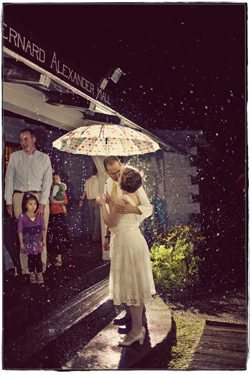 A heartfelt thank-you to everyone who sent kind wedding wishes to Gareth and me, either here on the blog or on our Facebook pages or direct to us via e-mail. We tied the knot on Saturday, September 12th at a children’s summer camp, Camp Wing in Duxbury, Massachusetts, and we are now MARRIED! I am keeping my name so you needn’t start referring to me as “Mrs. Hinds” (though I won’t be offended if you do).
 y assessing what the customer wants, even when they’re not sure, and more quickly finding a book for them to consider. Often I will just hand the customer one book to look at. I find sometimes that pure confidence in your choice makes it easy for the customer to trust the selection.
 Perhaps one of my favorite books of all time, Sector 7 is a wonderful adventure. There is something so magical about this wordless book. Every time I show it someone I discover something new. Because it’s wordless, it works for a myriad of ages from toddlers through adults. Every once in a while, I have to really walk someone through the book, because they don’t trust a book without words, but once I get going, usually they’re right there with me.
 I think of these as less common than the usual chapter books out there. I absolutely adore Johanna Hurwitz’s series that begins with Pee-Wee’s Tale. Take a guinea pig who teaches himself how to read by readin
 g the newspaper on the bottom of cage, throw in a Central Park adventure and you’ve got a great book for emerging readers. The other series I love to give to new readers is animal-based as well, More Favourite Animal Tales by Jill Tomlinson. This is a collection of three of the books; they are also available as single stories (there are six stories in all). These feature animals having real human emotions. I like that both of these are series books, so kids can really sink in and enjoy.
 s. The first, Shug, is a fun book to recommend to girls (and boys) who want a little romance but aren’t ready for more than a first kiss. The book rings so true that kids actually handsell it better than I do. For kids who want more of a fantasy, The Last of the Really Great Whangdo
 odles is one of the all-time favorite handsells at the Flying Pig. I came to the book as a adult because my partner Elizabeth read it 25 times when it first came out in the 1970s, and it’s just so good.
 t’s Sarah Dessen. Dreamland is my favorite book of hers because it takes the topic of abuse and really sheds a light on it. I always suggest that parents and kids read this one together. Another book that’s great fun to hand to readers looking for something different is Feed. Nothing sells a book better than the first sentence of this book: "We went to the moon to have fun, but the moon turned out to completely suck."
 Remember those friendly middle-grade novels where kids have everyday problems and their parents, while flawed, are not only functional but are also loving, funny, exasperated, and kind? Well, there’s a new one in town, folks, and it’s charming.
 Gianna has a great outlet for her energy and anxieties: she’s a runner on the track team, a star sprinter. But unless she can bring up her grades and complete the leaf project on time, she won’t be able to compete in a very big meet. The obstacles between Gianna and her completed leaf project are many; some are comical (a scene where she essentially steals a leaf from the principal’s yard is very funny), and some are more serious (a running rival has it in for Gianna and her project; Gianna has a legitimate excuse for one lost deadline when her grandmother goes missing). There’s a budding romance that starts when her feelings for Zig start to confuse her.
 Messner (shown at left) is wryly observant but always warm in her portrayal of her characters. She herself is a seventh-grade teacher in addition to being a writer, which gives her school scenes and kid dynamics that added ring of authenticity. The characters are well-rounded and memorable, there are plenty of laugh-out-loud moments, and Gianna is a great kid you’ve surely met somewhere in your life. It was frankly a surprise to me how well the author wrote about a disorganized character, since
  she is one of the best-organized people I’ve ever met.
 She also brought leafy branches she laid out on two tables in the front of the room for kids and adults to identify after her reading (which was excellent,
  by the way—clear and engaging and just long enough) and she came prepared with prizes for everyone who identified any two leaves out of the three or four types. The tables were humming with activity. Turns out it’s not THAT easy to identify leaves. We used tree identification booklets; Kate brought several of these, an amazing little resource called Tree Finder: A Manual for the Identification of Trees by Their Leaves by May T. Watts, one of a group of pocket field guides worth investigating. (At left, a group of leaf investigators.)
 This event was terrific not only because it had a good turnout (thanks in part to Kate, who supplements bookstore promotion with her own mailings and social networking skills), but also because the atmosphere the author created was one of collaboration and warmth. Not only did she thank the bookstore for hosting the event, she praised independent bookstores as a vital and necessary and valuable part of the fabric of a community. She also took the time to introduce to the audience several authors who were attending her reading, a gracious gesture that spoke volumes about her generosity—a trait she shares with her characters.
 oxes that have flooded my store (have I mentioned the tractor trailer truck from Hachette last week that unloaded so many boxes, my staffer kept saying, "This must be a duplicate order"?) I have noticed some downright lovely books featuring art.
 picture book pages, each page features a sentence and an art piece. It’s not as simple as the alphabet book, some of the phrases are meant to be puzzled over. For example the phrase "Light spilling everywhere" is accompanied by the painting Landscape at Zaandam. The light isn’t as obvious as it could be, and the painting draws the viewer, making you seek out the warmth of the sun. I don’t know that all kids will have patience for this book, but for parents who take the extra effort and encourage their kids to just look and not get impatient, I suspect this book could become a requested favorite.
 15 Works of Folk Art. by Deborah Raffin and paintings by Jane Wooster Scott. Mitzi is a charming black and white little dog wearing a red collar, traisping through some really lovely folk art paintings. The objects to find vary from easy to a little more challenging. I particularly like the catchy rhymes that direct the reader on what to search for. Not only are there many things to look, but all the seasons are represented as are different settings, country, farm, city, etc. Kids who might be a little young for the Where’s Waldo books will love this, as will parents and grandparents who favor folk art There is some really great end matter that explains the different styles of folk art and asks what kind of styles were used in the book.
  ictures: An Introduction to Art for Young People, Revised Edition by Joy Richardson. This book uses art from the renowned British National Gallery. The layout of the book is from the prospective of filling and organizing a gallery. Children who may be thought of more as inventors will actually pore over this book. There are fascinating details on restoration, repairs and using modern techniques to learn more about each piece. Charlotte Voake has added illustrations throughout to point the reader toward some informational tidbit or art technique. This book is a great sampling of what the world of art history can hold — it’s not just old paintings, there are stories to be told. Each choice of the artist has a reason and they are presented with humor and insight that will make the curious want to know more.
 We’re currently conducting an interesting exercise at Wellesley Booksmith that I thought some of you might like to participate in as well. This October marks the 10th anniversary of our store’s opening, and as such our front window will be featuring our staff’s individual selections of the best book each of us has read in the last 10 years. (Not the best book published in the last 10 years, mind you, the best book we’ve each READ in the last 10 years. This means we don’t have to get picky about publication dates!) We plan on asking our customers to write to us about their "best in 10" choices too, and will publish their responses in our store’s biweekly newsletter — one or more per week for the next year, just to keep the celebration going.
  The happy couple on their engagement day.
 Hoo boy, have I got a
  Ever since the August 27 ShelfTalker post,
  a) The Internet has enabled public gathering places (like this blog and many, many others), where cross-cultural communication is so much easier than it used to be. (“Cross-cultural” here refers to bookselling, teaching, library, publishing, artist, author, etc., cultures, although the other meanings are also applicable.) Getting the word out about great books featuring kids of color can hit mainstream channels, if we all take care to do it.

 A corollary to this is that some day soon, marketing departments will need to stop doing an end-run around the cover-art question. By this I mean the attempt to overcome the (lamentably very real) challenge of selling book covers to white audiences by obscuring or omitting race from book covers. They may show characters from the back, or blur them, or use such extreme facial closeups it’s hard to work out race, or use only the white character on the front cover of a book that equally features a character of color. The new cover of E.L. Konigsburg’s Newbery Honor book, Jennifer, Hecate, Macbeth, William McKinley, and Me, Elizabeth (shown at left) goes this route, and the image has a lively quality, but it ignores the heart of the book: the friendship between Jennifer and Elizabeth. I’m not sure my nine- or ten-year-old self would have picked up the new cover, but the original image (shown at right) drew me in immediately. As an adult, it made me sad to see that Jennifer, the dominant figure in the friendship, had disappeared from the 2007 edition, and to think about the probable reasons for that decision.
 I understand the impulse, and often, it works—not only because of latent (or blatant) racism, but because book covers have shaped reader expectations. As Carol Chittenden astutely pointed out in her comment on the Ramona Quimby blog post, perhaps part of the problem lies in what readers have grown accustomed to expect from books with kids of color on the cover: “I would have to voice some sympathy with publishers who soft-pedal skin color in cover designs. I often see older customers’ faces cloud over when I present such great books as Elijah of Buxton, and they dismiss it with, ‘I don’t think he’d relate to that one. What else can you show me?’ Kids seem to have far less of a problem with that, and when the cover figures are a group, a mix doesn’t seem to be an issue. There’s such a strong assumption that if the character on the cover is dark-skinned, the book is about race.”

 I think we have a chance here to continue changing public perception. We need to keep talking, and back up our words with actions. Let’s not make lazy assumptions about what kids will and won’t read, and what adults will and won’t consider buying. This goes all the way from authors and illustrators to agents and editors, publishers and marketing departments, then booksellers, teachers, and librarians. If we all shift a little, a lot can happen.
 ow for the books that DO exist: TA-DAH!! Our
  There are lots of great books, I’m happy to say. Not enough, by a long shot, but this discussion has brought to light dozens of 2009 titles and scores of pre-2009 titles, not to mention a nice starting handful of 2010 titles.
 Please keep in mind that this is a work-in-progress, and that I’m sure I’ve made some tagging whoopsies along the way, particularly with the categorization of 48+-page books that don’t quite fit our usual definitions of picture books, early readers, or chapter books. Feel free to email me with corrections — or, better yet, make them yourselves in the Common Knowledge section of each book. I think I also went a little nuts and included some titles that are more about race and ethnic heritage than the original intent of this list. But better to err on the side of inclusivity, I think.