Yearly Archives: 2009

And the Award for Best Bookstore Cat Name Goes to…


Alison Morris - June 19, 2009

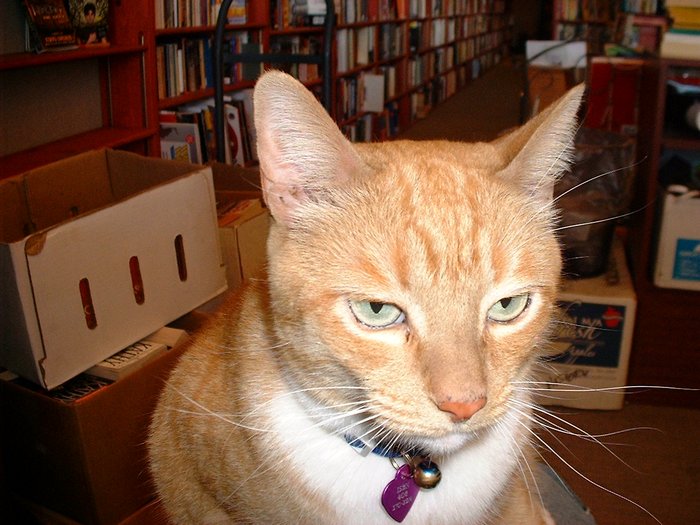
Here’s a random fact I stumbled upon recently: Recycle Bookstore West in Campbell, Calif., has a store cat named Isbn. Yes, Isbn, as in ISBN. How clever is that?? Without a doubt, this is the best name for a bookstore cat that I’ve come across as yet in my many years of bookstore travels.

The photo of Isbn below is one that appears (along with some very favorable reviews!) on Yelp, but others can also be found in the Flickr accounts of Klara Kim and meowhous.


A year ago I blogged about Veruca, the tortoise that makes his home at Rivendell Books in Montpelier, Vt., and who also happens to sport a great book-related name. Have you had or known a pet with a great bookish name? If so please immortalize them here and (in so doing) offer inspiration to other book-loving would-be pet owners.

The Fine Art of Reading Customers


Elizabeth Bluemle - June 18, 2009

Training staffers to read customers’ signals can lead to much better, more successful experiences for both customer and bookseller.

In Robert Altman’s delicious film, Gosford Park, Helen Mirren plays Mrs. Wilson, the impeccable head housekeeper of an English country manor. Toward the end of the film, Mrs. Wilson reveals the secret of her efficacy to a young lady’s maid: "What gift do you think a good servant has that separates them from the others? It’s the gift of anticipation…. I know when they’ll be hungry and the food is ready. I know when they’ll be tired and the bed is turned down. I know it before they know it themselves."

While retail is certainly not servitude—though it can feel that way sometimes, har har—it is a form of hospitality. Tto be a good retailer means to be a good host, sensitive to the needs and anticipating the whims of the customer.

After nearly thirteen years of bookselling, we’ve gotten a pretty good handle on what customers, wittingly or not, are trying to say to us—not only with their words and tone of voice, but with their body language. This kind of "reading" comes more naturally to some folks than others, and certainly is refined through experience. So it occurred to us that bookseller colleagues might welcome a little tip sheet for staffers who might be newer to retail or just not as attuned to the signals customers telegraph. The examples below aren’t comprehensive, but should serve as a basic guide to the kinds of things we encounter on the floor, at the register, and after the sale.

On the Floor
A customer’s approach into the store is immediately telling. If someone walks in the door and strides toward you or the checkout counter, she’s obviously on a mission and knows what she wants—and a bookseller had better be ready to ring up that gift card or find that special order, pronto. If someone comes in and goes immediately to a particular section, he knows where he’s headed and probably wants to browse there without help or interruption, at least for a while. A quick hello suffices there. If customers come in hesitantly, looking around, this is likely a first visit and needs to be handled with just the right balance of welcome and space: you want to establish contact so they know whom to ask for help, but not smother them with the kind of boutique-y attention that sends many customers (myself included) running for the door.

As a general rule, we like to greet customers with a quick, friendly hello when they walk in, then let them settle into the store before offering help. Your hello tells them you’re there, paying attention, available if needed. (That initial contact from a salesperson has also been shown to reduce shoplifting.) A customer’s hello tells you even more: a brusque or hesitant reply generally means, "Please leave me alone to browse. I’m not ready for / interested in personal interaction right now." It’s really important to let these customers be. Like many of us, they prefer to browse on their own and feel hovered over if salespeople are overly solicitous. Body language signal: a turned-away of the body or head indicates a desire for distance and independence. Crossed arms are a definite "leave me alone" sign. Most of these customers, once they’re comfortable in the store and secure in the knowledge that you are not going to stand over them, will relax and let you help them if they need it. (One caveat: customers who avoid eye contact and won’t engage even to say hello might merely be socially awkward, but an avoidance of sales clerks is also a hallmark of many shoplifters, so just be alert.) We try to make sure we connect with every customer two or three times: once when they come in, usually once during the browsing process, and a sincere "thank you" when they head out, whether or not they’ve made a purchase.

Though we generally leave customers alone to browse, our job is to notice when customers need help, and respond quickly to that need. Even the most independent shopper might want help finding a title; in fact, these shoppers are the most likely to leave a store if they don’t find what they’re looking for quickly. They’re not thinking, "I wonder if they have my book in overstock, or in another section, or can order it for me?" They’re thinking, "Not here. Go elsewhere." So how do you know when or if you should check in again with someone? Their behavior gives you a clue: someone scanning the shelves up and down quickly is not finding what he or she wants. The same is true of someone who goes back and forth between two or three sections; something is missing, and our job is to help them figure out what it is.

We train our staffers to offer help after a few minutes, but from a distance. "Let me know if you’d like help finding anything," we might say from behind the counter or as we pass by, arms full of books to shelve. Call it customer psychology, but if you really want to be asked for help, get busy doing something else, and the people will flock to you with questions. (It’s some form of Murphy’s Retail Law: the customer will want the most help when you are least able to provide it, and vice versa.)

Body language is huge when you’re recommending books to customers. They will literally lean toward you and a book when they’re interested, and lean away or step back when they’re not. Kids are particularly funny about this: kids (especially ages 6-10) who don’t know you, and who are not yet as schooled in politeness as most adults, may actually silently refuse to take hold of a book you’re showing them if they aren’t intrigued. When this happens, I either move on to the next recommendation or, if it’s a great book I’m pretty sure the child will love, I reassure them that they don’t have to commit to any book they take a look at, and that they might find it worthwhile to read a page or two of the proffered title. I also let them know that these are just suggestions, and that they certainly won’t hurt my feelings if they decide not to get a book I’ve recommended. "You want the right book at the right time, a book you’re in the mood for," I tell them, and—the pressure lifted—they usually are willing to take a look at whatever book with an iffy cover but terrific insides I’m trying to hand them.

Some people only want one or two choices to choose from; others want personal shopping assistance for as long as you can give it. When customers have reached their fill of recommendations, you’ll see their gaze start to wander and they will seem distracted. They’ll start nodding and saying "uh-huh" to your every sentence; they’re being polite, but really, their minds have gone elsewhere. They cannot absorb another book. This is your cue: find them a place to sit with the little stack of books, suggest they make their yes-no-maybe piles, and let them be.

Noticing customers’ body language will help you gauge their interest and comfort level and adjust your own sales behavior accordingly, backing off or stepping up when appropriate.

Handy tip—if a customer, child or adult, is vacillating between two books, try this: take the books, shuffle them behind your back, and then say, "Pick a hand." (Sometimes, a child might resist, thinking they’ll be stuck with the one they pick; if this happens, reassure them that they don’t HAVE to take the one they choose.) When the book they’ve chosen is revealed, watch their expression and ask, "Did your heart sink or leap when you saw this one? Did you kind of want the other one, or is this the one?" Usually the answer is suddenly clear. This little game works 99% of the time to help make the choice. The other 1%, a child will say, "I don’t know. They’re both the same." And that’s when you help
fu
lly say, with a mischievous smile at the parent, "Then I guess you should get both!" Or offer to put one on a wish list for their next visit.

At the Register
Nothing drives me crazier as a customer than being ignored while waiting to be rung up. Once people are in line, they’re generally done browsing and ready to get going. Employees should be aware of this; it’s so easy to make quick eye contact with people in line, smile, and say, "We’ll be with you shortly." That simple act does more to stop the sighing, fidgeting, and tapping of impatient people than just about anything else you can do short of shoving the people ahead of them out of line.

If you notice a really impatient person (again, the heavy sighing and tapping of a foot or fingers will be your obvious clues), you might check in with them quietly while you’re helping someone else, asking "Are you in a hurry?" When they inevitably say yes, offer a solution: "Would you like me to ring this up and wrap it while you’re doing some other errands nearby?" or, "We’re open until six if you’d like to come back." Often, kind-hearted customers ahead of the rushed customer will hear this exchange and offer to let that person ahead in line. When that happens, I often joke, "Flying Pig triage," which usually gets a tension-relieving chuckle, and I make sure to thank the person who’s generously let the other customer cut in. That’s a win-win situation; everyone feels good, acknowledged, helped or helpful.

After the Transaction
While no one likes waiting in line, and most people telegraph at least a little impatience while waiting their turn, once they get up to the counter, they often become expansive, even chatty. This is when your inner retail host has to be most graceful—you want this time with your customer, because the relationship is real, because you’ve seen their kids grow up, because you know their dogs’ names, because you are a community member with ties to many of your customers and an interest in all of them. (Well, all but that one imperious, entitled customer you wish would find another bookstore to terrorize.) You need this time, but you also must be aware of those waiting for your attention, too. Again, being aware of the bodies around you and what they’re communicating is the key to keeping a balance between enjoying catching up with a customer and risking alienating the goodwill of the next person. If someone is chatting with you for too long, oblivious to the people behind her, your own signals can help: make eye contact and nod to the next person in line, reaching out a hand for their book to ring up, while saying something like, "It’s always so great to see you!" to the person you need to nudge along. Whatever you say and do, of course it must be genuine; fakeyness, even for a good cause, is always a huge turn-off and easily scented.

On the other hand, sometimes it’s the staffer who lingers too long, chatting with a customer who is actually trying to get out of the store. Feet give away a person’s intentions; if a customer’s feet are pointing toward the door, then even if their body is turned toward you, they’re on their way out. They’re chatting but secretly want or need to to get on with their day. If you can help your staff read the feet, you can avoid the pitfall of being friendly past the natural expiration date of the interaction.

Addendum: Kelly, one of our very well-read staffers (and I mean that in both senses of the term ‘well-read’), just mentioned another body-language signal savvy booksellers should note: the lingering goodbye. This is related to the ‘tricky follow-up question.’ Let’s say a customer has come in seeking a particular book that you happen to be out of. You place it on order for the customer, and let them know when it is likely to arrive. Some booksellers stop there. But unless that customer immediately heads right back out the door, he or she wants something else. A lingering customer is hoping to find something to take home. That’s your opportunity to ask, "Are you in the middle of a book right now, or would you like a recommendation?" This is the tricky follow-up question; you don’t want to be sales-y, but you are sensing a need, you are in fact a bookseller, you are surrounded by great books, and your customers love to read. There’s nothing to lose by trying to meet that need. It may turn out that your follow-up conversation leads to the customer remembering an unread book on her stack at home. That’s fine, too. She will leave feeling like she’s had a terrific customer service experience when there is no expectation hidden in the invitation for her to buy another book. And she’ll be back.

***
Booksellers and customers out there, what signals do you wish the person on the other side of the counter would pick up on?

The New Literal Mind


Elizabeth Bluemle - June 17, 2009

I’ve noticed a strange trend among grandparents these days, and sometimes among parents: the tendency to reject a book for not being specifically, literally representative of their child’s world. "Oh, he won’t read that," they might say. "It’s a city book, and they live in the country." Or, "Oh, no, she’s got a little SISTER, not a little brother. Do you have something with a little sister?" (Yes, we do, but maybe that book is a little less wonderful than the one with the little brother.) Or, most disheartening of all, a whispered, "I don’t think he’ll really be interested in that," when the child’s skin color on the cover does not match the child’s skin color in real life. (I’ll add here that only white customers make this kind of comment; customers of color — even if they were so narrow-minded — wouldn’t have the luxury of limiting their children only to books about kids like themselves; there just aren’t enough. But that’s a separate post.)

Do these adults think children won’t make the leap? Whatever happened to imagination, metaphor, curiosity? To encountering the unexpected, or trying on new lives through the windows of a book? In my experience, that’s in large part what books are for. As a child growing up in the sand-colored deserts of Arizona, I loved reading about kids in New York City, or the swamps of the south. I did enjoy the odd book about my own landscape, in part because there were so few of them, but if I’d limited myself to books about kids like me in a setting like mine, I’d have likely been bored, for one thing, and grown up with a very narrow world view, for another. In fact, thinking about it, the only Southwest stories I really loved were Native American stories, which fascinated and enchanted me. I was living my life; the magic of books lay in getting to live someone else’s.

As we all know from reading to children, and having been children ourselves, something inside us needs stories that expand us. Children are already open to so much more than most adults; they don’t even notice characters’ skin color—they’re in it for the story. And they’re always, always hungry for something new and fun and interesting and meaningful.

Most days, I have the energy to gently encourage these literal-minded customers to give farther-afield books a chance (and to give their grandchildren a little more imaginative credit). Once in a while, though, I cave, and hand Grandma the book she really wants, with a character that has her grandson’s name and lives her grandson’s life. That happens when I can tell a customer is so set in her way of thinking that whatever I say will fall on (metaphorically) deaf ears.

The increasing literal-mindedness is showing up here and there in children, too, and it disturbs me. It used to be that naming your new stuffed animal was practically a sacred rite of passage in plush parenting; now, if the tag on the creature doesn’t provide a pre-fab name, we’re seeing kids at a loss, calling their new dog "Puppy" and their new cat "Kitty." What happened to Alexander Sassafrass and Robbily Susan? I find myself getting this mischievous, mad gleam in my eye and finding a way to steer that family toward Old Possum’s Book of Practical Cats.

We have many missions as booksellers, but it’s a strange world when one of them is the need to defend children’s curiosity and imagination against the instincts of some of their most loving and well-intentioned guardians. On those days, I just want to see kids playing outside somewhere, absorbed in the microscopic world of bugs and fairies or forts and treehouses, tattered book lying open on the grass, icy glass of lemonade sweating in the sun. Or, if they’re city kids, playing in the stream of a hydrant, giggling and squealing with their friends, and sharing stories.

I’d love to hear some of your most effective tactics for getting adults to trust children’s open-mindedness and willingness to visit lands and lives beyond their own.

What a Great List


Josie Leavitt - June 16, 2009

I am impressed. Last week when I asked for summer reading suggestions, 31 people offered some truly wonderful suggestions. Click here and you’ll be able to see the whole list.

It would seem that just about everyone suggested The Hunger Games — clearly this was the most popular book on the list. This book is a smart choice to have a reading list because the kids will be excited to see it on the list and even happier to read it, especially with the sequel coming out in September. Sherman Alexie’s The Absolutely True Diary of a Part-Time Indian was equally popular. There were 87 books on the list, and 57% of the authors were women. This is the striking difference with the school lists I’ve gotten this year. I’m not sure what this means other than it makes me happy. So often these lists are the "classics" and that usually means male authors aside from Austen and the Brontes.

This list is exciting. It’s full of great modern characters that kids can relate to, and isn’t this what a reading list is supposed to do? Laurie Halse Anderson’s Chains was another book populating many lists.  Every book by John Green was on the list more than once. Finally, someone is paying attention to young adult males who actually like realistic fistion. Historical fiction was nicely represented as well. Sometimes what’s lacking in school lists is balance. It’s either too skewed to to classics, with nothing published after 1970, or it’s a land of science fiction and fantasy.

Our small sampling made me wish I was a student at this school of reading. I would have been overwhelmed by great choices and read far more than the required number. Please feel free to comment on the list, if there’s something fabulous that you feel is missing. We can continue to grow the best summer reading list, ever.

What to Do, What to Do?


Josie Leavitt - June 15, 2009

Now that schools in Vermont are officially on summer break, I’ve noticed something I’m not sure how to handle.

School let out on Friday and since then I’ve had four nine-year-old girls ask for one or more books in the Twilight series by Stephenie Meyer. Now, don’t get me wrong, I think Twilight is a fine series. I enjoyed it immensely when I read it. I am forty-four, not nine. I’m not sure what to do with this current phenomenon. I don’t like to judge purchases by anyone in my store, but this troubles me.

These bouncy, pigtailed nine-year-olds seem to have no reason to read these books other than "my friends are reading it." They don’t even like boys. I find asking them "Do you like boys?" is a great weeding-out question for some of the younger set. A giggle, and a sheepish "no" can usually sway them away from any book, except Twilight.

Well, this is the first time in 13 years of bookselling that I’ve had a real problem with a trend. I just think it’s wrong for innocent nine-year-olds to read a book about a vampire love story centered on a 17-year-old girl who loves a vampire. Yes, the first book is fairly innocent, but as the books progress so does the mature behavior, marriage, sex and a fairly intense birth scene. And I wonder how many parents would let their nine-year-old daughters, or sons for that matter, read any other book that dealt with such mature themes.

My fear is twofold — the first is they are coming to a good book too early and they won’t get out of the book what they would if they read it at the right age. The second issue is now that these girls are reading about characters so much older, they won’t have patience or the desire to read about children their own age. It saddens me that for three years parents who have put their foot down to their daughters who wanted to read Twilight before they were 12, have lost the will to make their kids wait. I worry that girls will think Harriet the Spy is too young for them, that The Great Gilly Hopkins has nothing to do with their lives, Walk Two Moons isn’t relevant. It pains me when nine-year-olds head right back to the young adult section and bypass the riches that make up the middle-grade section.

There are reasons books are written for the middle-grade set — they are appropriate for that age child, with maturity level they can handle and a complexity of the story with characters who speak to a child who is eight to twelve. As I explained to a befuddled Dad, kids who are nine and ten and go straight to young adult sometimes don’t come back to the books that were written for them. And that to me is the real tragedy in all of this.

So, how do I, as a bookseller, gently sway parents from buying a book their child is so obviously happy to read, but I feel is far too old? It’s a question I’ve been grappling with, unsuccessfully, for weeks. Any tips would be greatly appreciated.

Self-Publishing Tips


Josie Leavitt - June 12, 2009

As the owner of an independent bookstore, I get approached at least twice a week by self-published authors asking me to sell their books. The world of self-published books has changed a great deal since we’ve been open. The quality is vastly improved — even Kinko’s can produce a handsome book. The challenge becomes how to distinguish your book from the multitude we see a year.

I’ve amassed a list of what I’d like to see happen to make this growing area of bookselling as beneficial as possible for both parties. I’ve had some great success with self-published books. So if you’re an author, don’t despair, you can almost always get your book on the shelf. One thing I’ve changed is that now I’ll take one copy of any self-published book on consignment. This involves no risk on my part and it allows your book to spend some time on the shelf.  Just know that shelf space is at a premium. If after three months, the book hasn’t sold, it may wind up in the back room until there’s more room on the shelf.  

One cardinal rule: if you want me to carry your book and you live locally, you should make an effort to shop at my store.

Do: Make your book look as professional as possible.

Don’t:
Have a spiral wire binding (unless it’s a church cookbook), laminated pages or folders.

Do: Send an email with details about your book. I love emails; I can’t misplace them and I can quickly refer to it when I need to. And they give me an easy way to contact you.

Don’t: Come to the store unannounced and expect me to drop what I’m doing to review your book. There’s nothing that puts me off more than this. Respect my time and I’ll be much more disposed to look favorably on your book.

Do: Call to follow up on the email you sent.  This reminds to review the email if I’ve missed it.

Don’t: Be hurt if I don’t remember your book right away. We see lots of books. My lack of memory means nothing, other than I just don’t remember. It’s not a condemnation of your book.

Do: Try to leave a reader’s copy if you want me to carry a novel. I do try to read them and if I like the book, I’ll happily take several copies.

Don’t: Get mad at me for asking for a copy to read. I know it’s expensive to have extra books; if you can’t have a copy for me to read, then maybe an excerpt would be good. I can’t just have things on the shelf I know nothing about. So give me so info that can help me sell your book.

Do: Try to price your book within the market ranges. I know picture books can be expensive to print, but a $25 paperback picture book will be hard to sell.

Don’t: Not listen to your local bookseller’s advice. No one knows the market better than your local indie. Listen to their hesitations about carrying the book. See what you can do to modify the price. We had one self-published book that was really overpriced; we recommended a different printer and she got a much better price. As a consequence of the lower price we were really able to sell the book. I think by the time the print run ran out, we’d sold over 200.

Do: Think regionally.  You’re much more likely to get your book placed if it’s got something to do local region. We’ve had good results with a book about boxers in Vermont.

Don’t: Expect a Vermont bookstore to carry a book about California ponies. 

Do: Have an invoice for consignment available when you want me to carry your book. In a perfect world, I would have my own form, but sometimes we run out, and it’s really helpful if you can keep track of the paperwork.

Don’t: Expect me to buy three copies of your book. It’s not personal; it’s business. Better to have the book on the shelf than not at all. We sold thirty copies of a Chapbook on consignment and it worked out well.

Do: Tell your friends and the press (if you live locally) that your book is available at my store.

Don’t: Not tell me if you’re going to be featured in the local paper.  Nothing is more frustrating than getting caught by surprise by not having a book on hand that’s been featured in the paper.

On the whole, the future looks bright for self-published books. With the increase in quality, the stigma of self-publishing is going away. Remember to make your book look as professional as possible and be patient.  We want you to succeed and nothing is more exciting than seeing a self-published book take off.

One new Don’t: Please don’t use the comments field to promote your own book. Those comments will be edited. This is a space for conversation, and as tempting as it may be to mention your titles, this isn’t the right venue for that. Thanks for understanding.

On the Street Where You Read


Alison Morris - June 11, 2009

Picture a world comprised of book covers, book spines, and people cut from actual book pages. That’s the world created by Apt Studio and Asylum Films in the stop-motion video "This Is Where We Live" that they produced for the 25th anniversary of 4th Estate (an imprint of HarperCollins in the U.K.) some seven months ago, though I only just stumbled upon it today, completely by accident! I love the whimsical quality of this short film and am especially taken with the thought of paper birds emerging from paper trees. Beautiful!

If you enjoy this video you might also enjoying taking a peek at the production stills and watching the short time-lapse films of the animators cutting out scenes, the production team building the sets, the crew filming the shots, etc.

This Is Where We Live from 4th Estate on Vimeo.

Summer Reading Should Be Fun


Josie Leavitt - June 9, 2009

I am really glad I’m not a kid this summer. I have just amassed all the summer reading lists for the schools in our area. Why do so many schools feel compelled to force classics and only classics on kids during the summer? Why not mix it up, with some classics and some more current books? I understand wanting to expose to the classics because of the wrting and big themes, but these things exist in lots of Young Adult literature.  I’d get creative if I were planning an entire summer reading list — such as, if you want to read Twilight you must also read Bram Stoker’s Dracula.

I am very curious what you Shelftalker readers would put on a summer reading list for kids in the 7th to 12th grades. Next week I’ll tally the results and we’ll have our own Shelftalker list.

I’ll get the ball rolling with four of my choices:

The Human Comedy by William Saroyan
Collected Stories of Eudora Welty by Eudora Welty
The Hunger Games by Suzanne Collins
The Book Thief by Markus Zusak

So, let’s make a great list!

Yes, I Think About These Things


Josie Leavitt - June 8, 2009

It seems once a week or so, I like to voice an opinion about the publishing world. Today, my thoughts alight on invoices. I’ve been in this business now for thirteen years and I’ve come to know the different publishers’ invoices all too well. It’s minutia, but it’s my world.

Let me walk you through a shipment. We order the books, the books arrive in at least one box, often times several boxes, and then the fun begins. Where oh where is the invoice or packing slip that allows us the receive the books? Some publishers, most in fact, will indicate on the box which one has the needed papers. Although I’ve yet to discern the magic behind which box the distributors put the invoice in. But then, where in the box is the elusive slip? You’ve got to root around the box to find the paper. Some publishers leave it on top. More often than not, it’s crumpled at the very bottom of the box and there’s no way to Houdini it out there, like whipping a tablecloth out from under a china setting, without taking out all the books.

I’ve noticed a trend with shipments these days: duplicate information in the guise of a packing slip and an invoice. In Simon & Schuster’s case they are identical, as far as I can tell, and they’re stapled together.  If they’re stapled together, do I really need a packing slip? Why not just the invoice, which is the piece of paper that I keep? Ingram and Baker & Taylor have packing lists in every box, which is fine, I guess, but then you still to have cross-check everything against the invoice. One thing I love that Ingram does and wish more publishers would take up, is a packing list taped on the outside of every box. This way, when eager customers come in, I can scan the boxes quickly and efficiently, thus impressing the impatient shopper when I can find his book quickly among the six boxes I’ve gotten in that day.

Oh, this is a total pipe dream, and slightly off topic, but wouldn’t it be great if the our boxes could get packed so our special orders were all together in one box and we didn’t have to rip open all the boxes to organize all the special orders. Wouldn’t that revolutionize the holidays?

Once we’ve found the invoice and now must check off what’s come in. There are no uniform-sized invoices in publishing. Penguin seems to have the smallest, although they have this weird habit of having a page of invoice info and then a "This page intentionally left blank," followed by more book info, and another page "intentionally left blank." So, what should be a two-page invoice turns out to be four pages with half the pages blank. Surely, the printers at Penguin can just keep printing an invoice rather then skipping every other page.

If I get a big shipment in, we generally tear the invoice apart, rebuild it and staple it, so it’s easier to manage.  Random House invoices are very wide, with about eight columns of information: the UPC code, the ISBN 10, the ISBN 13, the number of books per carton, then what you ordered and the price. I really only need three of these columns, but must wade through all of these to get what I need. Oh, and is it just my aging eyes, or does Random House seriously need to get some toner? The print is so faded I can barely read the numbers. These invoices can only be processed by our younger staff. These two publishers have only black print on white paper with very little space between the lines. This can make it difficult to see.

MPS invoices are just enormous. There’s the book info which is large, easy to read and nicely organized with contrasting blue and white paper and black ink. Then there’s the whole bottom part, about three to four inches long, that’s blank. It’s perforated and must be torn off from the main invoice. Again, I wonder, why can’t the paper and the printer work together to eliminate waste and bookseller irritation? However, given the choices, I’d much rather have an invoice I can easily read, so if I must tear off paper, then so be it.

I know this is totally mundane, but, in a perfect world here’s the invoice I’d have: large enough to easily read, with every other line of the paper a different color, only the ISBN 13 number (although secretly, I haven’t switched to it yet, so I just type the 10 digit number), the quantity I ordered, the price and my discount, and it would include the shipping charges, thus saving me the inevitable phone call to find out what they were.  The paper would be of a normal size with no waste, intentional or not. 

Oh, and all the discounts would be a little bit higher.

After BEA, the Work Begins…


Josie Leavitt - June 4, 2009

Better than a Sham-Wow: great ideas from BEA that actually work!

The following is my compilation of the most important things I need to do since returning home from BEA.

Oh sure, BEA was fun, but now it’s time to implement all the ideas we heard about. I can’t help but remember what John Rubin said last year at Winter Institute, that if we didn’t implement new ideas within 10 days, we weren’t going to. Okay, I’ve been home five days and I’ve made some awesome lists, but it’s time to lay it all out so I can make sense of it. So here goes.

The educational session, Thought Leadership, has really lingered with me. The main thing I’ve absorbed is thinking differently about getting into the school system and how this can lead to future sales down the line. The whole premise of Thought Leadership is how to patiently build relationships within your community and having the faith to know that it will pay off with future sales. There are book fairs which everyone conceded were not good money makers; however, they are a great way for the school community to see what makes your store stand out from Scholastic’s book fairs. And it gives you a great chance to showcase your unique stock. I will now try not to say "no" to the next school that asks me to do a book fair. I’ll say "yes" and see what happens.

The other thing I really learned from this was to become a provider of continuing education credits for teachers.  Take book talks and a teacher night which most of us do already. If your store registers with the local district office, you can get set up as a provider of continuing education so the attending teachers can use it to fulfill three hours of continuing education credits. You continue to provide your expertise, but now your target audience can get even more out of your presentation. You can also take the show on the road and help provide part of an in-service day for schools. You get paid a nominal fee for the service and your store is exposed to more teachers than might otherwise come in to shop. I just love this idea. It’s the perfect marriage of what the store already does and what local educators need. I will update this as I progress through set-up and implementation.

One piece of advice I came away from the Small and Medium Store Roundtable was to not check my email as often as I do. It can distract from my real list of things to do. Every morning, or right before bed, I will make a list of four to five things I would like to accomplish. I will keep the list doable and not leave work until they’re all done. I think a five-item list stand a very good chance of getting done. Often putting out the small fires of day-to-day retail can get in the way of the big picture, like getting into the schools. So, one of my list items will be a step toward reaching a long-term goal.

The last thing I want to get done is send the follow-up emails to the publicists I met. Each one said in response to my inquiry of arranging an author visit was, "Send me a proposal." Okay, proposals are item number one on tomorrow’s list.

In case you were like me and didn’t get to all the booths you wanted to find out about specials, this link will lead to a listing of all the show specials. Some theoretically expired with the show, although I’ve always found this to be a flexible deadline, especially if you call pleading while placing your order.

Summer is also a great time for huge deals. Penguin is having an awesome series of specials. If you need to restock the perennial favorites Nancy Drew, the Hardy Boys, Katie Kazoo, and Hank Zipzer, there is a great buy-two-get-one-free deal which works out to saving a whopping 66%. There are more specials so contact your rep for all the details.

Random House, long known for not having specials, is having a great one through the end of July. Place a minimum order of 50 units and you get an extra 3%

So, like a Sham-Wow, I hope this post can be used again and again to make your bookselling life easier and maybe more fun and profitable.