 Our Catching Fire release day party was the perfect example of how Josie and I balance each other out in the bookstore. She’s a morning person, so she suggested opening at 8 am for the kids who couldn’t wait to get their hands on the book. I’m a night owl, and wanted to host brunch, not breakfast, for teens who, like me, probably wanted to sleep in. We compromised, and it turned out we were both right. She opened at 8 and, sure enough, sold a dozen copies before officially opening the store at 10, and I hosted the party upstairs in the Flying Pig Loft at the very reasonable hour of 11 am. I planned the party, and she made sure we actually had the supplies necessary to pull it off.
Our idea was to have a training camp competition for Tributes. Preparations included setting up the Loft, clearing lots of space for the archery and nerf disc gun stations (it’s roomy up there, so that wasn’t a problem), buying and/or gathering materials for these training stations, creating a system to keep track of the kids’ scores, and getting snacks and juice for the kids (in this case, we went with Fig Newmans and Newman-O’s, because I’m on a kick with those, and some lemonade and berry juice). We also got a bag of mixed Halloween candy for exit treats. Paper cups and napkins, some rope, a few tables, some Nerf toys, a timer, pen, sterilizing alcohol, some parachute men, bagel knots, and a couple of EyePops were all we needed.
We’re short-staffed this week, with our two high-schoolers gone and one of our adults on vacation, so there were just two of us up in the Loft, me and my colleague, JP, who was a children’s librarian for 30 years before she came to work at the bookstore so is a crack hand at events. The kids arrived in three main groups; this was unplanned, but worked out well. We had 16 "Tributes" in all, three of whom were girls, the rest boys. They ranged in age from 8 to 14. The younger kids hadn’t read the book; they had heard about the party and wanted to come. Sixteen kids isn’t a large number, but it’s not too shabby for the last day of summer (school started on Wednesday for the kids), not to mention a weekday mid-morning event. I think it’s safe to say the kids had a blast — and so did JP and I. Here’s how it worked:
 First: SIGN-IN. Tributes checked into the training center, recording their names, phone numbers, and District number of choice. They received the two puzzles below and were instructed to put them in their backpacks for later. These were a crossword puzzle and a word search I made up with clues from The Hunger Games (not from Catching Fire, since I didn’t want to give anything away). Contestants who bring back either completed puzzle (or both) by this Friday will be entered in a prize drawing. Our cheerful, helpful Scholastic rep, Nikki Mutch, sent a box of Catching Fire pins to give away. We’ll also use hot ARCs as prizes. (Note: everyone who buys a copy of Catching Fire this week also gets the puzzles.)


(Note: my photos are a little lacking. We were too busy running the stations to take pix during the event, so we ended up staging shots after the party with some of the kids who stayed after. I had to use my phone to take the pics, which didn’t help. Then I imported them to a PC instead of my Mac, and edited them with some crazy, unfamiliar program that ended up making everything look grainy and strange and messed up the color. Apologies! But I think you’ll get a sense of the party, at least.)


 TRAINING STATION 1: ARCHERY. This was really fun and grabbed the kids’ interest immediately. Josie had bought a cool toy bow that shoots Nerf missiles. We set up an easel with a sheet of posterboard and balanced a paper cup on top of the easel. A direct hit to the cup earned 5 points; a hit to the posterboard that knocked over the cup earned 2 points. Each contestant got a practice shot and then had three tries to topple the cup. (The highest score was 12.) JP and I kept score and replaced the cup between shots. Once contestants had finished the archery round, they moved on to Station 2.

 TRAINING STATION 2: KNOTS. This was simple to set up. We took a spool of nautical rope and cut it into lengths of about 18", then propped open a copy of The Daring Book for Boys. Pages 10-11 have instructions for tying 3 fairly simple knots. Each knot successfully tied was worth 2 points. (In the picture at right, the boy in the background is working on the knots challenge with JP standing by. The boy in front is at Station 3.) JP and I went back and forth between the archers and the knot tyers and getting the new Tributes set up.


 TRAINING STATION 3: PROBLEM SOLVING. We had parachute men and bagel knots. The challenge was to make successful Sponsor Gifts by tying the bagel knot to the parachute man (no piercing of the bread was allowed) and floating it down from the loft (there’s an upstairs loft in the Loft, which is why it’s called the Loft, you see?). Only two kids at a time are allowed up the circular staircase, and surprisingly, they were really patient about it. They had as much fun watching each other’s parachutes float down as they had floating their own. A cute thing I wasn’t expecting is that every single kid ate his bagel knot after it landed on the floor — even though we had extras for eating at the snack table. I don’t know why that charmed me so much.


 TRAINING STATION 4: SHOOTING PRACTICE. Josie had found a battery-operated Nerf disc gun at the same toy store where she found the bow and arrows. This required another big cleared lane for shooting. We’d set up small and large paper cups on the window ledge. Each Tribute had to line up next to a little flying pig doorstop we have and aim for the cups. Landing in a big cup earned 2 points; landing in a small cup earned 5 points. This was a tough challenge, because the gun tended to shoot discs in a leftward arc, so even with 10 tries, it was tough to land a single disc. I think someone earned 7 points, and that was the highest score. JP landed her very first test shot; I was impressed.

 TRAINING STATION 5: BREATH CONTROL. We
  had two EyePops (thanks to Kenny Brechner, at whose store I discovered them), mint-flavored rubbing alcohol (! I guess they make this for thermometers on the theory that it won’t have such a hideous taste, but the kids assured me that it was still vile), and sterile wipes. EyePops are little plastic pipes with frog- or crocodile heads and little baskets on top that hold two Nerf eyeballs. The challenge is to blow into the pipe, raising the eyeballs into the air, keep them there for as long as possible, and then lower them safely back into the cups. Tributes got a practice run, and then were timed (using the stopwatch function on my phone; I have to say, the phone came in really handy during this party!). They got to take the best time out of three successful runs. The lowest score was a little over 2 seconds; the highest was 7 seconds. One of the older boys was so great, taking over the timing and helping instruct the younger kids while I signed in some new Tributes. The kids were great about letting me sterilize the pipes in between each kid.
 LAST STEP: After the kids were done with all challenges, they gave us their score sheets to keep
  and tally. Scoring Stations 1-4 was easy, a simple points system. We scored the breath challenge by looking at the range of results (2 to 7 seconds) and assigned points on a 6-point scale, using half points where needed.
We had candy in addition to the snacks (which were totally gone by the end of the party, which surprised and amused me; kids are completely hollow, aren’t they?), and each kid chose two of those treats to take away at the end of the event.
THE AFTERMATH: The winners of each Station will receive their choice of prize ARCs, and the overall winner will win a copy of the third book in the series. All the kids’ score sheets will be included in the prize drawing along with the readers who turn in their completed word search and crossword puzzles.
How does one judge the success of an event? Sometimes it’s book sales. But these kids would have bought the book whether or not we had an event. So in a case like the Catching Fire party, it’s all about community goodwill, and camaraderie, and fun. I think the fact that the kids hung around after finishing their stations, talking about The Hunger Games and going back to take challenges again, was a pretty good sign. Some of their parents had to drag them away. And one of our great customer kids, one of the older boys at the event, just knocked me out; he and his friend were the last two left, and when his friend said, "Okay, let’s get going," this kid said, sotto voce, "Let’s help clean up first." And his friend said, "Yeah, yeah, sure," and they actually zipped around the Loft throwing away used juice cups and paper napkins, restoring Nerf discs to their holders, and gathering up the parachute men from their flung positions. Now don’t get me wrong, they aren’t saints — saints would have untangled the snarled parachute-men strings instead of holding them out and saying, "Uh, these are really a mess," and dropping them back on the table — but they are very close to, and I have a small lump in my throat just thinking about it.
I’m lucky lucky lucky to have the job I do, where I get to share books and parties with kids and families I just adore, who crack me up every day, who love reading, and have very good hearts.

 ly and sadly, much needed, discussion on the children’s bookselling listservs right now about what to do about books and toys that are damaged by customers. The discussion was begun by a very frustrated bookseller desperate for tips from other stores about what to do about stopping merchandise from getting damaged. It’s interesting — what struck me was rather than tons advice being offered, it was the torrent of stories from other booksellers eager to share their nightmares of how things got damaged, or out-and-out rude customer behavior. I’m not going rehash the bad behavior, but for you booksellers having a bad day, just know: it’s so not you.
 the book tends to get ruined by little and big hands alike. It gets very expensive to buy an extra book and sacrifice it for the display. Every once in a while, publishers will create a display dump that actually comes with a display book. Penguin went one further with Tomie dePaola’s Brava, Strega Nona: A Heartwarming Pop-Up. If you bought the dump, not only did you get a display copy, but the dump was actually a stand where people over four feet high could look at and play with the book, and below the display was where you stacked your neatly-wrapped-in-plastic stock of the book. Absolutely brilliant idea. I know display copies are expensive for publishers, but let’s face it, no one will buy a pop-up that’s not wrapped, even if they’re the first one to open an unwrapped one.
 atching Fire. I am up this early because my dogs wouldn’t sleep past 4:32 a.m. and I thought, wow, I’ve got so much to do, I might as well get a jump on things.
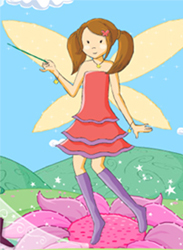 For a few years now, some of the hottest fairy properties on bookstore shelves have been
  It seems to me you’d have to have enormous resiliency, not to mention a generous sense of humor and/or deep ethnic pride, to grow up black in this country. One of the many things I hope will come out of having Barack Obama as President is publishers’ embarrassed realization that, heck, there’s not a whole lot out there in the children’s book world featuring kids like Malia and Sasha. That is, books with black characters who lead 21st-century lives in a vibrant world of ethnic diversity. Books that aren’t about slavery, civil rights, and the struggles of interracial relationships. Those stories are vital and must be told—both the brutal and the inspirational—but just as 2009 American Jewish kids don’t see themselves primarily in the context of the Holocaust, neither do black children live in the past. They, like all children, deserve to be active, lively participants in the children’s literature of the present.
 As a child of the mid-1960’s and 1970’s, I had the great good fortune of growing up at a time often referred to as a golden age in children’s book publishing. The likes of Ezra Jack Keats and Virginia Hamilton and Walter Dean Myers were unleashing their genius on the world, and in the heady culture of mainstream embracement of hippie ideals, racial representation in books was in some ways more inclusive, broad, low-key yet celebratory, and therefore “realer” than it feels (at least to me) today. I was a Free to Be…You and Me child, a Ms. Magazine ‘Stories for Free Children’ reader, and I wonder how we’ve gotten so far from those promising, inclusive days.
 As a bookseller, it’s mortifying to have so few multiracial options to offer parents and kids—both white and black. It’s wildly frustrating to come up against, time and again, the erroneous assumption that white kids will not want to read about non-white kids. That is one of the most ridiculous pervasive myths in all of bookselling. Is Corduroy (interior illustration at right) not one of the most beloved classics of all time?
  Do children hesitate to pick up Looking for a Moose (left) by Phyllis Root because there are brown faces on the cover? In The Stories Julian Tells, can white children not relate to Julian and his little brother Huey “accidentally” eating up all the dessert before dinner? Do white parents eschew The Snowy Day because Peter is black? Is E.L. Konigsburg’s Jennifer, Hecate, Macbeth, William McKinley, and Me, Elizabeth less appealing to kids because one of its two main characters is black? (I was extremely disappointed to see that the new cover for that marvelous Newbery Honor book, while well designed, now omits the black character.) Are children reading Mary Hoffman’s Amazing Grace unable to put themselves in her imaginative shoes even if they aren’t black, or a girl? (Do I need to answer these rhetorical questions?)
 In some ways, we’ve come so far as a country.
  But the powerful influence of the nation’s publishing media hasn’t caught up. Nowhere was this more obvious than the recent disturbing events concerning the choice to put a white girl on the cover of a book about a black girl (Justine Larbalestier’s YA novel, Liar. This issue has been widely covered in the trade and blogosphere; for background, check out the
  This choice to use a white girl shocked, but shouldn’t have surprised, me; book marketing can be an extremely cynical operation. Larbalestier’s U.S. publisher is certainly not the only house that has found itself on similarly iffy ground, and, to their great credit, they have chosen a replacement cover image that, if
  Her little brother loves to dance. Their parents—a brusque, traditional, lawyer father and a lovely, passive mother—are not thrilled with their children’s choices, and a family dramedy is born. In the book, race is only an issue inasmuch as it is an issue in Emma’s life, if that makes sense. That is, it’s one of many consuming issues in her life, but not (in her case) the primary one. Still, one of my favorite moments in the story is when Emma messes with her white Upper East Side classmates, who stupidly assume she’s from “the ghetto” because she’s black, though her family is easily as wealthy as any of theirs. She is annoyed and amused by their assumptions; it’s a delicious moment of awareness for readers from both sides of the